In this article
An overtime-related row can show a complete amount for certain hours, or it can show only an additional component beside base earnings recorded elsewhere. Those displays look different. Comparing their labels without checking the relationship between rows can make equivalent fictional arithmetic look inconsistent.
The examples here are display exercises only. They do not decide who qualifies for overtime, which hours count, what the legally required regular rate is or whether an employer's method complies with law. All hours, rates and row definitions are supplied assumptions. Use the exercise to ask what a record means, not to establish an entitlement.
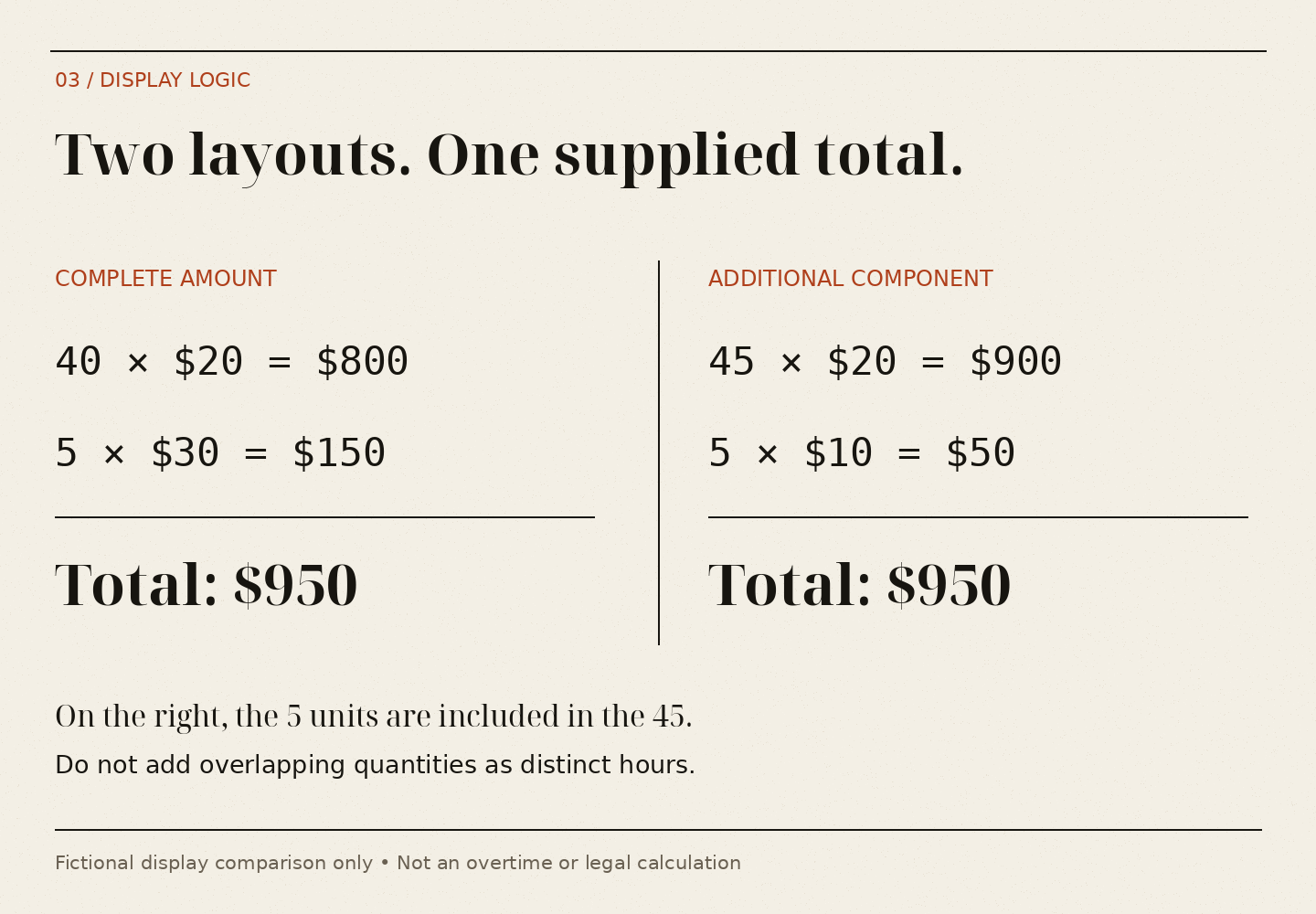
Two displays, one supplied total
Suppose a fictional payroll explanation says that 40 units are paid at $20.00 and 5 other units are shown at $30.00. A complete-amount display would show $800.00 on the first line and $150.00 on the second, giving $950.00. The quantity and rate labels tell us how that particular example is constructed.
Now suppose a different fictional display says the base line includes all 45 units at $20.00, or $900.00. An additional line then shows 5 units at $10.00, or $50.00. The total is again $950.00. In this second display, the five units overlap the base line's quantity. They are not five more distinct units to add to forty-five.
The two layouts express different decompositions of the supplied total. One puts $30.00 per relevant unit on a separate row. The other puts $20.00 per unit in the base row and another $10.00 in a component row. Neither illustration is a claim about the layout your employer uses.
Locate the base amount before interpreting the premium
A row called OT, premium or overtime adjustment does not reveal its arithmetic role by itself. Find the accompanying base row and ask whether that base quantity includes or excludes the quantity on the additional row. Without that answer, you cannot know whether the apparent rate is complete or incremental.
A useful question is, “Does this row show the entire earnings amount for those units, or only an additional amount after base earnings are recorded elsewhere?” This avoids assuming that a small-looking rate is automatically incomplete. It also avoids assuming that a large-looking rate is necessarily correct.
An explanatory legend should identify both rows. A response saying “that is the premium” may still leave you uncertain about where the base portion appears. Ask for the relationship, not merely an expanded abbreviation. The goal is to reconstruct the printed subtotal using the employer's stated definitions.
Avoid the double-counting trap
Return to the second fictional display: $900.00 base plus $50.00 additional component. If a reader instead adds another five units at $30.00 to the existing $900.00, the result becomes $1,050.00. The extra $100.00 comes from counting a base portion twice. The error is in the reconstruction, even though each isolated multiplication is correct.
This is why a total-hours calculation deserves its own question. Forty-five plus five is mathematically fifty, but that addition may be conceptually inappropriate when the five is a subset of the forty-five. A shared quantity can be used in more than one component without describing additional work.
Draw a bracket around the repeated quantity in a private fictional sketch. Label one occurrence “included in base” only if that is a supplied fact. The bracket makes overlap visible and reduces the temptation to treat every row as independent. When the overlap is unknown, mark it unknown rather than choosing the more familiar presentation.
A changing rate adds another reading problem
Consider a fictional record containing two base rates in the same covered period. A reader might try to pair an overtime-related component with whichever base rate appears nearest on the page. That visual shortcut is unreliable. Row order is not a formula.
This article does not calculate a regular rate from multiple forms of compensation. Instead, ask payroll which inputs and period its calculation used, and how the resulting amount is represented on the statement. If the displayed number comes from a calculation not fully shown, multiplication of the visible columns may be insufficient to reproduce it.
Keep three things distinct: the earnings codes present, the employer's explanation of their calculation, and any question about the applicable legal requirements. The first is visible, the second needs evidence, and the third may require qualified advice. Collapsing them into one conclusion makes the discussion harder to resolve.
Corrections can interrupt a familiar pattern
An adjustment may refer to an earlier earnings period even though it appears beside current rows. A negative component may reverse a prior amount before a corrected amount is added. Neither should be treated as ordinary current hours without an explanation.
Imagine that a fictional correction section shows minus $50.00 and plus $62.00. Their net arithmetic effect is plus $12.00. That does not tell us why the original amount changed or which period it belongs to. The supporting explanation should identify the original row and the replacement relationship.
A good comparison therefore starts with the same record version and a clearly bounded set of rows. If the record was reissued, avoid adding the original and replacement totals together unless payroll confirms that they represent separate amounts. A familiar OT label does not resolve version history.
Finish with a display question, then a calculation question
The first inquiry is about presentation: which rows overlap, which amounts are complete and which are incremental? Once that is clear, a second inquiry can address the inputs or result. Keeping those stages separate gives payroll a specific explanation to provide and gives you a way to check whether it answers the actual uncertainty.
For the $950.00 example, a concise question is: “I can reproduce the total as 45 times $20.00 plus 5 times $10.00. Please confirm whether the five units are included in the forty-five, and whether the $10.00 row is an additional component.” That wording reports an interpretation for confirmation rather than announcing a legal conclusion.
Official Department of Labor recordkeeping guidance is useful background for the distinction between recorded hours and earnings. It does not certify these fictional displays or resolve an individual overtime question. If your concern goes beyond reading the statement, seek the relevant official or qualified assistance without waiting for this arithmetic exercise to settle it.
Sources and scope
Official context checked October 14, 2026. The methods and worked figures are original educational examples. No individual legal or tax determination, deposit forecast or account service is provided.