In this article
Three columns can look like an equation without actually being one. A row might show hours, a rate and an amount, but a nearby unit count, salary reference or informational rate can change what those fields mean. Read the row's label and units before multiplying anything.
This article offers a line-reading method. It does not determine the correct wage rate, decide which time must be paid or calculate statutory overtime. The distinction is important: a multiplication check can confirm that a displayed amount follows a stated formula while leaving the underlying inputs completely unverified.
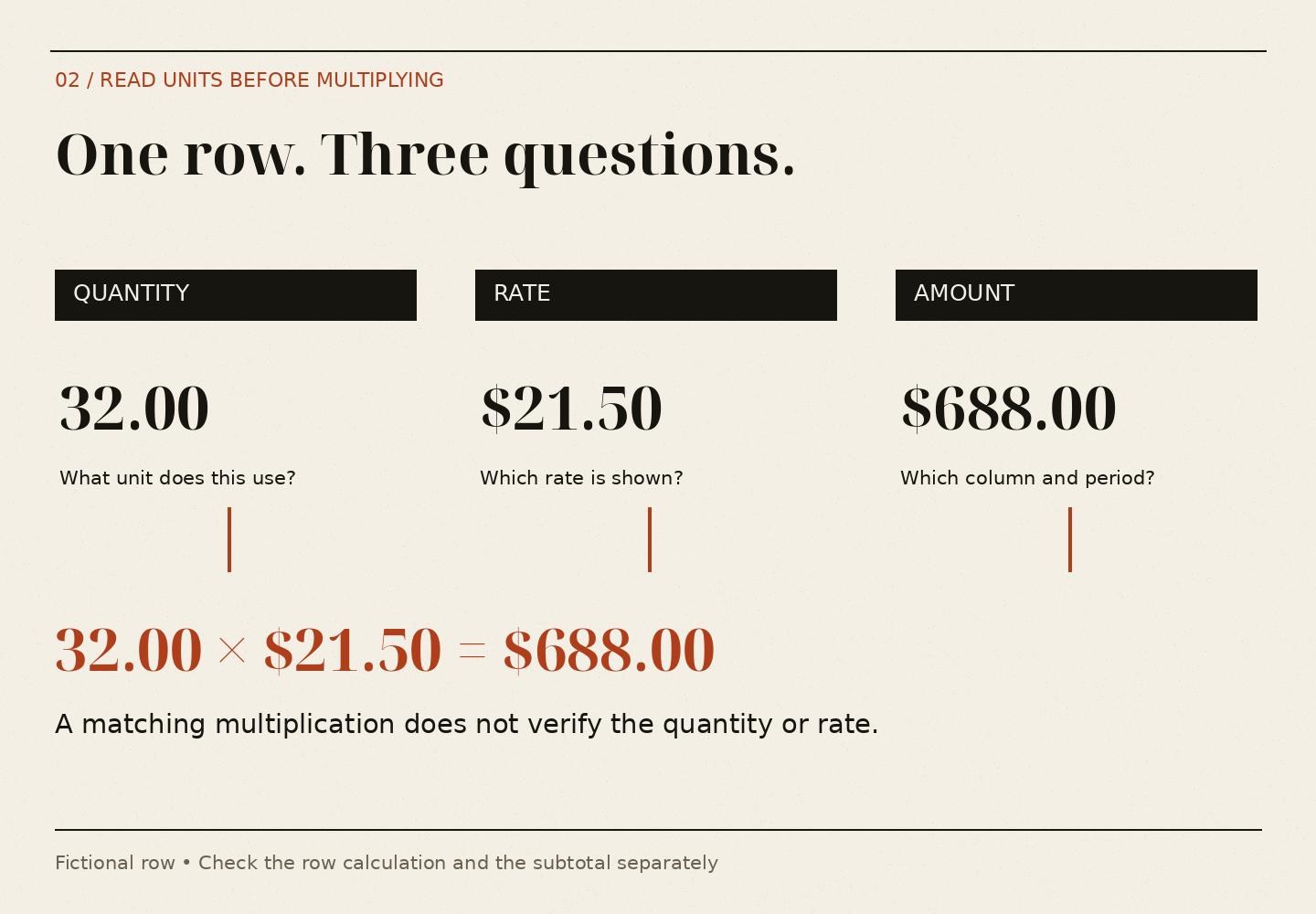
Make a sentence from the row
Start by translating the row into a literal sentence, retaining any uncertainty. “The row labeled REG shows 32.00 in the hours column, $21.50 in the rate column and $688.00 in the current amount column.” That is a readable observation. “I worked 32 paid regular hours at my correct rate” adds claims that the row alone may not establish.
For those fictional figures, 32 multiplied by $21.50 equals $688.00. The arithmetic agrees. You can now ask a more precise question if something still looks wrong: whether 32.00 is the intended quantity, whether $21.50 is the applicable rate or whether another row includes additional time. The calculation has localized the uncertainty rather than eliminated it.
Keep units visible. Hours, days, pieces and dollars are different measures. A column labeled units does not become hours merely because a previous statement used hours. A salaried earnings row may not be intended as the visible quantity multiplied by a displayed informational rate. If the record does not define the relationship, ask before imposing one.
Decimal hours are not clock notation
A fictional line showing 7.50 hours represents seven and a half hours if the system uses decimal hours. In that convention, the .50 part is half an hour, or 30 minutes. A note written as 7:50 commonly suggests seven hours and fifty minutes, which is a different quantity. Neither notation should be silently substituted for the other.
Take a $20.00 demonstration rate. A supplied quantity of 7.50 decimal hours gives $150.00. Seven hours and fifty minutes would require converting the minutes before multiplication. The purpose of this contrast is to expose notation, not prescribe an employer's timekeeping method or rounding practice.
If an exported report shows “7.30,” do not choose the interpretation that happens to make the amount balance. Ask whether that field is decimal hours, a clock-style duration or something else. A small legend can explain a large apparent discrepancy. Preserve the original entry and keep your conversion in a separate note.
Separate the row check from the subtotal check
Consider a fictional statement with 30.00 units at $22.00, producing $660.00, and 6.00 units at $24.00, producing $144.00. The two row amounts total $804.00. There are two independent checks: each multiplication agrees with its row, and the sum of the two rows agrees with the subtotal.
A reader who checks only the subtotal could miss a swapped rate. A reader who checks only multiplication could miss an omitted row. Write down both results. “Both rows multiply as printed; the current subtotal also matches” is more informative than a single tick beside the gross amount.
Now suppose the subtotal is $824.00. The $20.00 gap does not prove that either rate is wrong. There could be another earnings line, a correction or a different inclusion rule. Ask what belongs in the subtotal before changing the multiplication. Working backward from the total can tempt you to invent an input that the record never supplied.
Do not sum repeated quantities blindly
Some layouts repeat quantities to describe different components of the same work. A shift-related line, premium line or allocation line may refer back to hours already shown elsewhere. Adding every number in an hours column can therefore produce a misleading total unless the report says those quantities are additive.
Imagine a record that shows 40 hours on a base-pay line and 8 hours beside a separate premium amount. That does not, by itself, establish 48 distinct hours worked. The eight might overlap the forty. The correct reading depends on the payroll legend and underlying record, not the position of the numbers on the page.
Ask, “Are these quantities separate hours, or does the second line refer to a subset of the first?” That question is useful even when every dollar amount multiplies correctly. It targets the relationship between rows, which is often the missing piece in a confusing statement.
Treat rounding as an explanation to verify
A displayed rate may have fewer decimal places than the value used internally. A quantity may also be displayed with limited precision. That possibility can explain why a multiplication using only visible values differs by a small amount, but it should not be assumed every time a difference appears.
For a fictional example, 3.00 multiplied by a displayed $18.33 gives $54.99. If the amount reads $55.00, record the one-cent difference and ask whether the underlying rate has additional precision. Do not declare the cent harmless or reconstruct an undisclosed rate as fact. The employer can explain the calculation actually used.
The same caution applies to adding rounded rows. Keep the visible sum separate from any explanation involving internal precision. Once the explanation is supplied, note what it applies to: that row, that earnings code or the report as a whole. A rounding answer for one field is not permission to dismiss future differences elsewhere.
Write a compact line-reading note
A useful private note can have five entries: exact label, printed quantity and unit, printed rate, printed current amount, and the relationship you tested. Add a sixth entry for the question that remains. Avoid copying unrelated identity fields or account details into the note.
The finished fictional question could be: “The SHIFT row shows 8.00 beside $1.25 and an amount of $10.00. Is that quantity a subset of the 40.00 shown on the base row, or an additional quantity? The dollars multiply, but I cannot tell how to interpret total hours.” This is an interpretation question, not an allegation about unpaid time.
The Department of Labor's recordkeeping fact sheet supplies general context about employer records; it does not decode a particular employer's abbreviations. A payroll legend or direct explanation is the next source for that task. If your concern is whether the time or rate itself is correct, keep that separate from the display-reading exercise and seek the appropriate review.
Sources and scope
Official context checked October 14, 2026. The methods and worked figures are original educational examples. No individual legal or tax determination, deposit forecast or account service is provided.