In this article
A number on a pay record can be perfectly clear and still answer the wrong question. Gross earnings describe one part of the calculation. A tax-withholding line describes another. A payment amount belongs to a later stage. Reading those numbers as if they were interchangeable makes even a simple pay statement feel contradictory.
The practical starting point is to separate three layers: the earnings calculation, the deductions and additions that produce a stated net amount, and the instruction that sends a payment somewhere. This article concentrates on the first two. It does not trace deposits or decide whether someone has received everything they are legally owed. Its aim is more modest and more useful at the kitchen table: find the exact line or relationship you want payroll to explain.
First, identify the document you are holding
A payroll statement, an employer earnings history and a card transaction list are different records. A payroll statement may show hours, rates, earnings categories, deductions and cumulative totals. An earnings history may summarize several payroll runs. A transaction list generally organizes movements in an account. A familiar employer name appearing on more than one document does not make their fields equivalent.
The official provider notice says that Fintwist is now Corpay Prepaid. Corpay presents PayCard as a payroll product and FlexCard as a business-disbursement product. Those descriptions provide context for a payment destination. They do not define the fields on an employer's pay record. This publication has no account access, and its arithmetic cannot tell you a card balance or the availability of funds.
For a private reading exercise, put the document's heading, covered earnings period, payment date and version in view. Do not put account numbers, tax identifiers or a full statement into this website. Work with the fictional figures below. If you later ask your employer a real question, use the employer's established private route and include only what the recipient needs.
Layer one: build the earnings subtotal
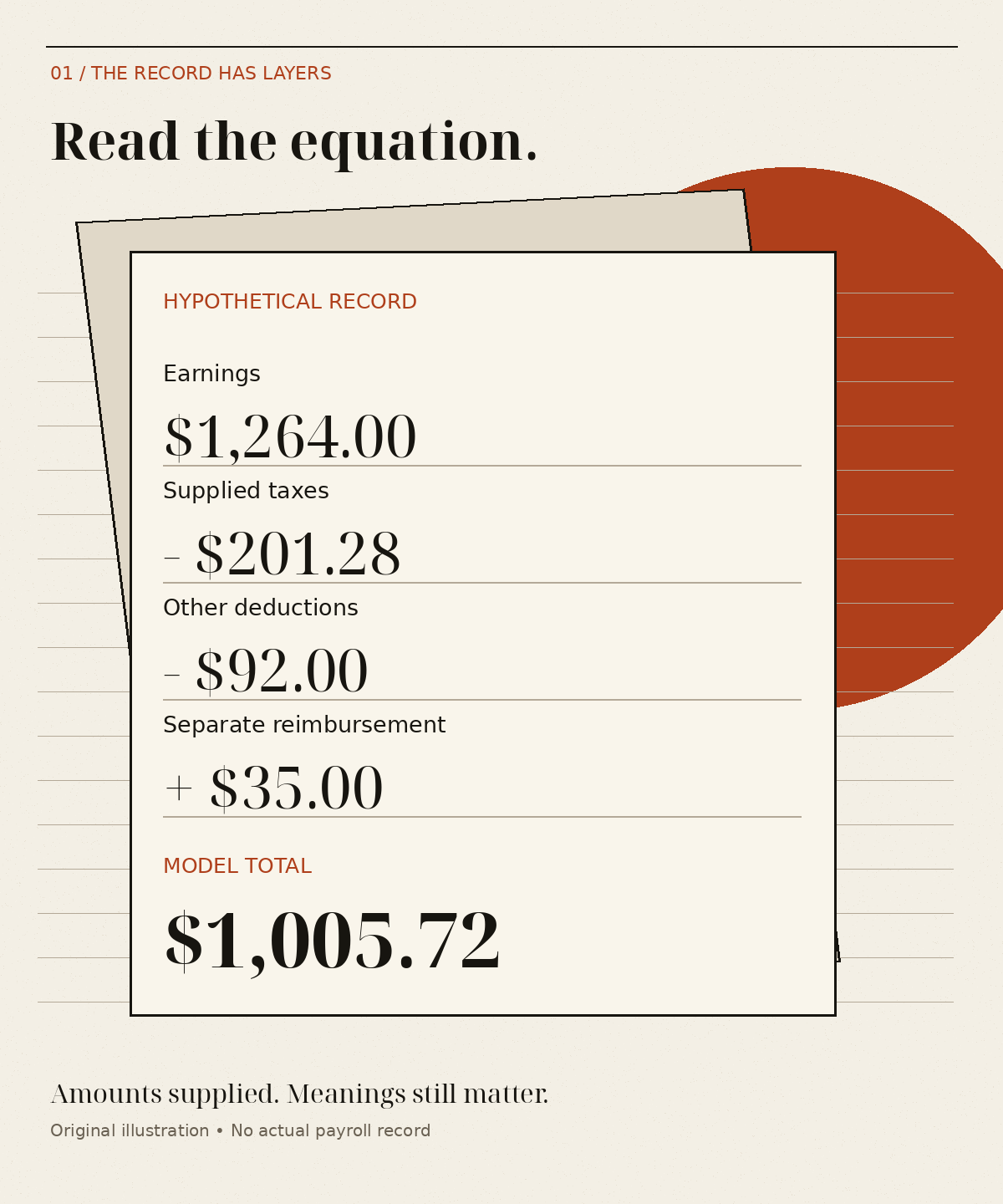
Imagine a fictional record for Rowan. It lists regular earnings of $1,120.00, an additional earnings line of $84.00 and a one-time earnings amount of $60.00. The visible earnings subtotal is $1,264.00. That is simply $1,120.00 plus $84.00 plus $60.00. We have not determined whether the amounts were calculated correctly, what each line means or what any law requires.
That distinction matters. Addition tests whether a subtotal agrees with the rows supplied. It does not test whether a row is missing. If Rowan expected another earnings category, a matching subtotal does not resolve that concern. The missing category requires a separate question about the underlying payroll record. Keep a note headed “included rows” next to the arithmetic, so that a successful sum is never mistaken for a complete review.
Some statements show employer-paid benefits, leave balances or informational values near earnings. Proximity is not proof of inclusion. Before adding a number, look for a section heading or subtotal that identifies its role. A value labeled employer contribution should not automatically be added to cash earnings. An hours balance is not a dollar amount. A current-period amount is not interchangeable with its year-to-date neighbor.
Layer two: use the amounts actually supplied
Now suppose the fictional record identifies withheld taxes totaling $201.28 and other deductions totaling $92.00. Subtracting those supplied values gives $970.72: $1,264.00 minus $201.28 minus $92.00. This example does not calculate withholding. The tax amount is an invented input, chosen to demonstrate the relationship among fields.
Next, suppose a separately identified $35.00 reimbursement is shown outside that earnings subtotal and is included in the record's final payment amount. The example total becomes $1,005.72. The word “separately” does important work. If the same $35.00 were already included in another subtotal, adding it again would double count it. If the reimbursement were paid through a different record, combining it here would obscure that separation.
The Net-Pay Equation Lab on the home page uses this narrow model. It adds supplied earnings components, subtracts supplied tax and deduction amounts, and adds a separately identified reimbursement. A reimbursement field is an arithmetic position in the model, not a tax classification. The lab does not decide whether your actual record uses that layout. It is a place to practice the equation with hypothetical numbers before examining a real statement privately.
Layer three: recognize the edge of the exercise
An amount calculated on a payroll record is not an account balance. A payment-destination instruction and an account's activity record have their own fields and questions. This article deliberately stops before that investigation. There is no reason to enter a routing number, card number, login or transaction history to understand how three earnings lines add together.
If a question concerns a payroll line, the useful description names that line and its position in the calculation. If it concerns an account transaction, a pay-record arithmetic exercise will not resolve it. Keeping that boundary visible saves time: it prevents a clear earnings question from becoming a speculative account diagnosis.
A record can also contain a payment allocation section. Do not treat an allocation amount as another deduction unless the statement actually defines it that way. The first task is to understand which subtotal the allocation is dividing. Its appearance below net pay does not mean it should be subtracted again to calculate net pay.
Read columns vertically before reading rows horizontally
A dense statement invites the eye to move across a row and grab the largest number. Try the opposite. Read every column heading first. Identify units, current amounts, year-to-date amounts and employer amounts. Then move down one column and select only the rows that belong in the same calculation.
For Rowan, a year-to-date regular earnings value of $17,920.00 could sit beside the current $1,120.00. Accidentally selecting the larger number produces a convincing-looking calculation with the wrong period. A calculator will faithfully add it. The protection is not a better calculator; it is a clearly named column and a consistent comparison window.
When a heading is abbreviated, preserve the abbreviation instead of inventing an expansion. “What does this heading include?” is a stronger question than a confident but unsupported translation. Payroll systems and employer configurations can use similar-looking labels differently. A legend or explanation for the actual record is more useful than a glossary from an unrelated employer.
A discrepancy is a question with a direction
Suppose Rowan's hypothetical statement displays $1,000.72 as its final amount while our selected rows produce $1,005.72. The difference is $5.00, with the displayed amount lower. That sentence is better than “my pay is wrong.” It says exactly which two values were compared and preserves the direction of the gap.
Before treating the difference as an error, check whether a $5.00 row was omitted, whether a subtotal already includes a component, whether the record has a correction or whether the selected total belongs to the same version. These are questions, not explanations. Do not quietly invent a missing deduction to make the equation balance.
If the two totals match, say what matched: the selected current-period rows reproduce the displayed total. That does not validate the rate, the number of hours, the treatment of a benefit or the lawfulness of a deduction. A good reconciliation has a defined scope. It is valuable precisely because it does not claim to settle every issue at once.
Turn the reading into a precise payroll question
A useful inquiry has four elements: the record being discussed, the field as printed, the comparison you made and the explanation you need. For the fictional discrepancy, that might read: “On the statement with payment date shown as October 9, the listed current earnings are $1,264.00, supplied taxes $201.28, other deductions $92.00 and a separate reimbursement $35.00. Those rows give $1,005.72, while the displayed total is $1,000.72. Which additional row or inclusion rule explains the $5.00 difference?”
The date in that illustration identifies a document. It does not promise a deposit date or establish a payment deadline. A real inquiry should use the identifiers your employer requests through its verified channel. There is usually no need to send every prior statement when asking about one column on one record.
Keep any response attached to the question it answers. If payroll explains that the reimbursement was already included in the earnings subtotal, revise the equation and note that inclusion rule. If it explains an omitted deduction, add the supplied row without assuming the same deduction appears in every period. If the response addresses a different total, clarify the mismatch rather than treating any reply as closure.
What the official recordkeeping source contributes
The Department of Labor Fact Sheet #21 describes employer recordkeeping requirements for covered nonexempt workers, including hours, earnings, additions, deductions, payment dates and covered periods. It does not prescribe one universal employee paystub layout. This publication uses that limited context to explain why fields deserve careful identification; it does not apply employment law to your situation.
Questions about compensable work, required rates, withholding choices or legal remedies require the appropriate qualified or official help. A reader need not finish this exercise before seeking that help. Arithmetic is a way to sharpen a question, not a prerequisite for raising a concern. The useful endpoint is a small, accurate statement of what you can see, what you calculated and what remains unexplained.
Sources and scope
Official context checked October 14, 2026. The methods and worked figures are original educational examples. No individual legal or tax determination, deposit forecast or account service is provided.