In this article
A minus sign on a pay record is a direction, not a complete explanation. It may appear beside an earnings correction, a deduction reversal or another adjustment. The effect depends on which section contains it and what earlier amount it relates to.
The task is to preserve the sign, identify the category and ask about the relationship. This article does not decide whether a deduction or recovery is permitted, whether wages are owed or how a correction must be reported for tax purposes. Those questions require their own facts and review.
Name the section before interpreting the sign
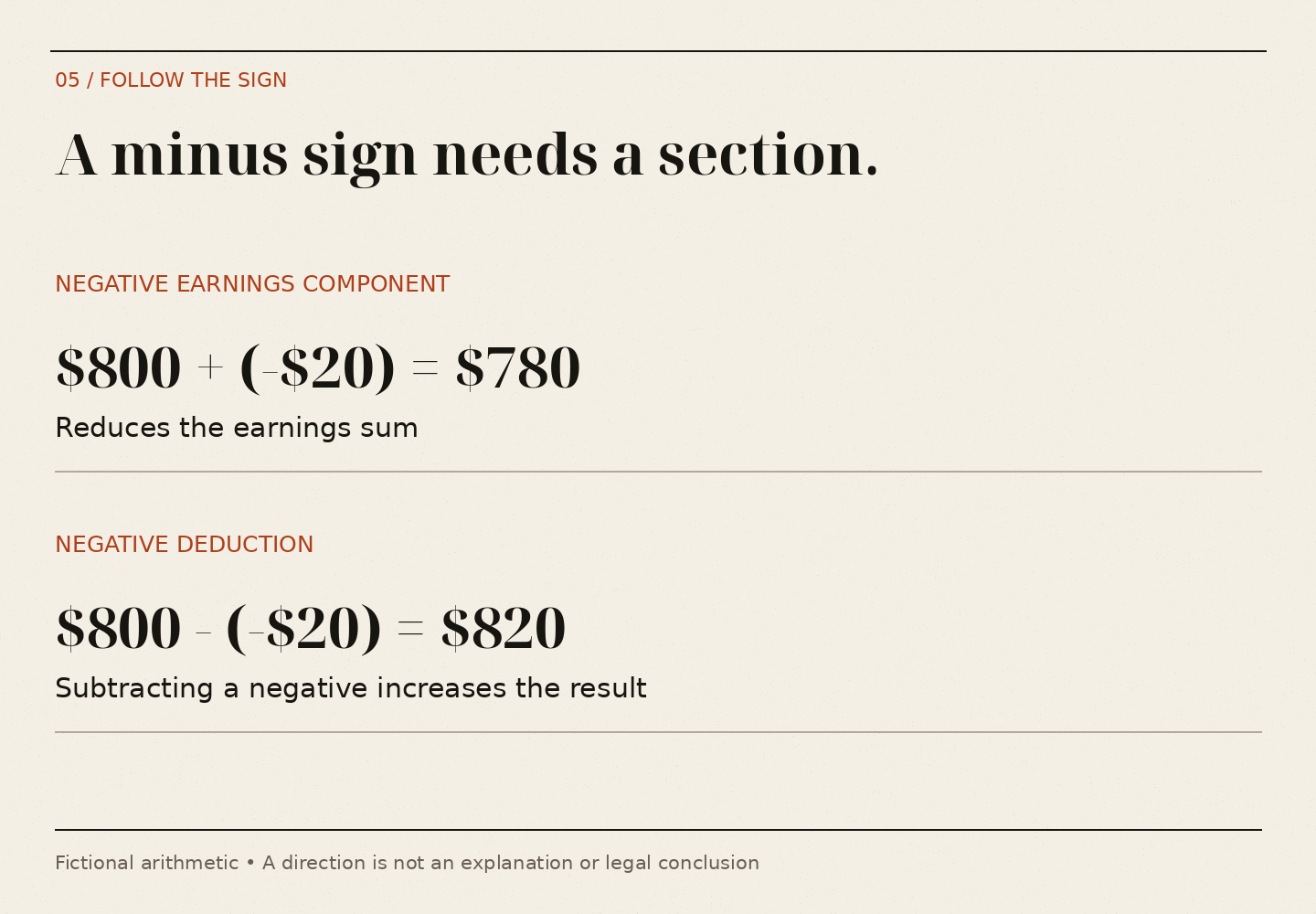
A negative earnings component reduces the sum of earnings components in a simple arithmetic model. A negative deduction, when subtracted, increases the remaining amount. The same printed minus sign can therefore have opposite effects on a reconstructed net figure depending on its role.
Use a fictional record with $800.00 of earnings and a deduction subtotal of minus $20.00. Subtracting negative $20.00 gives $820.00 before any other listed rows. That is different from adding an earnings adjustment of minus $20.00, which would reduce earnings to $780.00.
Do not move a signed number between sections for convenience. Write the section name beside it. If the record uses parentheses or a trailing minus sign, ask what that notation means in the system rather than assuming a convention from another document.
A reversal and replacement form a pair
Suppose a fictional correction shows an original amount reversed by minus $120.00 and a replacement amount of plus $135.00. The combined effect of those two rows is plus $15.00. The pair is not a $135.00 increase on top of the unchanged original amount.
The explanation should identify which original row is being reversed and whether the replacement supersedes it completely. Matching amounts alone do not establish the relationship. A negative $120.00 could refer to something else, and two positive $135.00 rows could represent different periods.
Keep the original record and the correction explanation distinguishable. A private note can say “original,” “reversal” and “replacement,” with the record reference for each. That small structure prevents a sequence of changes from becoming a pile of amounts with no history.
Do not combine superseded statements as payments
A reissued statement may replace an earlier version rather than add another payment. The date you downloaded it is not enough to decide. Look for version language and ask whether the new record is a replacement, an additional run or an informational correction.
Imagine an original fictional statement showing $700.00 and a revised statement showing $715.00. Adding them to get $1,415.00 would be inappropriate if the second supersedes the first. Subtracting them to get a $15.00 change describes the versions, but does not by itself prove that $15.00 was separately paid.
This publication stops at understanding the record relationship. It does not trace an actual deposit or tell you whether a balance includes the correction. Keep the payment-status question separate from the statement-version question.
Current and cumulative effects may differ
A correction can make a year-to-date comparison look unusual. If the current record contains both an ordinary earnings amount and a prior-period adjustment, the cumulative change may reflect both. If the correction is shown elsewhere, the current column alone may not explain the cumulative movement.
For a fictional bridge, earlier YTD earnings are $10,000.00, current ordinary earnings are $900.00 and a documented earnings correction is minus $30.00. The resulting YTD figure is $10,870.00. That is an arithmetic illustration of the supplied relationship, not a rule for every payroll system.
Ask whether the adjustment is already included in the current subtotal before subtracting it again. The safest note lists the exact rows used and the subtotal each belongs to. A clear inclusion rule is more useful than a guess based on where the adjustment appears visually.
Keep gross changes separate from net changes
If an earnings correction changes gross by $15.00, the stated net change need not be $15.00 when supplied taxes or other deductions also change. Reconstruct each version using its own rows. Do not assume every downstream field stays constant.
Suppose version one has earnings $800.00 and supplied combined deductions $160.00, giving $640.00. Version two has earnings $815.00 and supplied combined deductions $163.00, giving $652.00. The gross change is $15.00; the net arithmetic change is $12.00. Both statements can be accurately described without calculating any tax.
The missing question, if any, is why the supplied deductions changed by $3.00. A comparison reveals that change; it does not explain it. Ask for the relevant calculation explanation rather than assigning the entire net difference to one earnings row.
An adjustment note should be a small chronology
Use four entries: the original field, the correction field with its sign, the stated relationship between them, and the resulting arithmetic effect. Add the explanation source and record version. Keep uncertain relationships marked uncertain.
A fictional inquiry could read: “The adjustment section has minus $120.00 and plus $135.00. Are these a reversal and replacement of the same earlier earnings line? If so, which period and original record do they correct, and is their $15.00 net effect already included in current gross?”
IRS Publication 15 contains employer tax-adjustment guidance, but this article does not apply those procedures. Questions about the legality of a recovery or the proper tax treatment should go to qualified or official help. A well-labeled arithmetic note can support that conversation without pretending to settle it.
Sources and scope
Official context checked October 14, 2026. The methods and worked figures are original educational examples. No individual legal or tax determination, deposit forecast or account service is provided.