In this article
A final pay record and a year-end tax form can describe related earnings without presenting identical totals in every box. The strongest comparison starts with definitions, not an expectation that the biggest numbers should match.
This article helps organize a reading question. It does not prepare a tax return, determine reportable wages or tell you which form is correct. IRS W-2 instructions define distinct wage and withholding boxes; an employer's gross-pay label may have a different scope. The comparison needs a bridge between those definitions.
Identify the year and the version first
Confirm that the records being compared belong to the intended year and employer. A corrected tax form, revised final statement or later adjustment can change which version is relevant. Keep version labels visible rather than overwriting an earlier amount in a note without explanation.
A fictional file labeled Final Statement might simply be the last statement you downloaded. It may not include every later payroll correction. Ask whether another record contributes to the cumulative totals if the available documents do not explain them.
Do not include tax identifiers or full forms in this website. The examples below use invented figures and generic field descriptions. Real questions should use the employer's established private route or an appropriately qualified tax professional.
Compare named measures, not visual neighbors
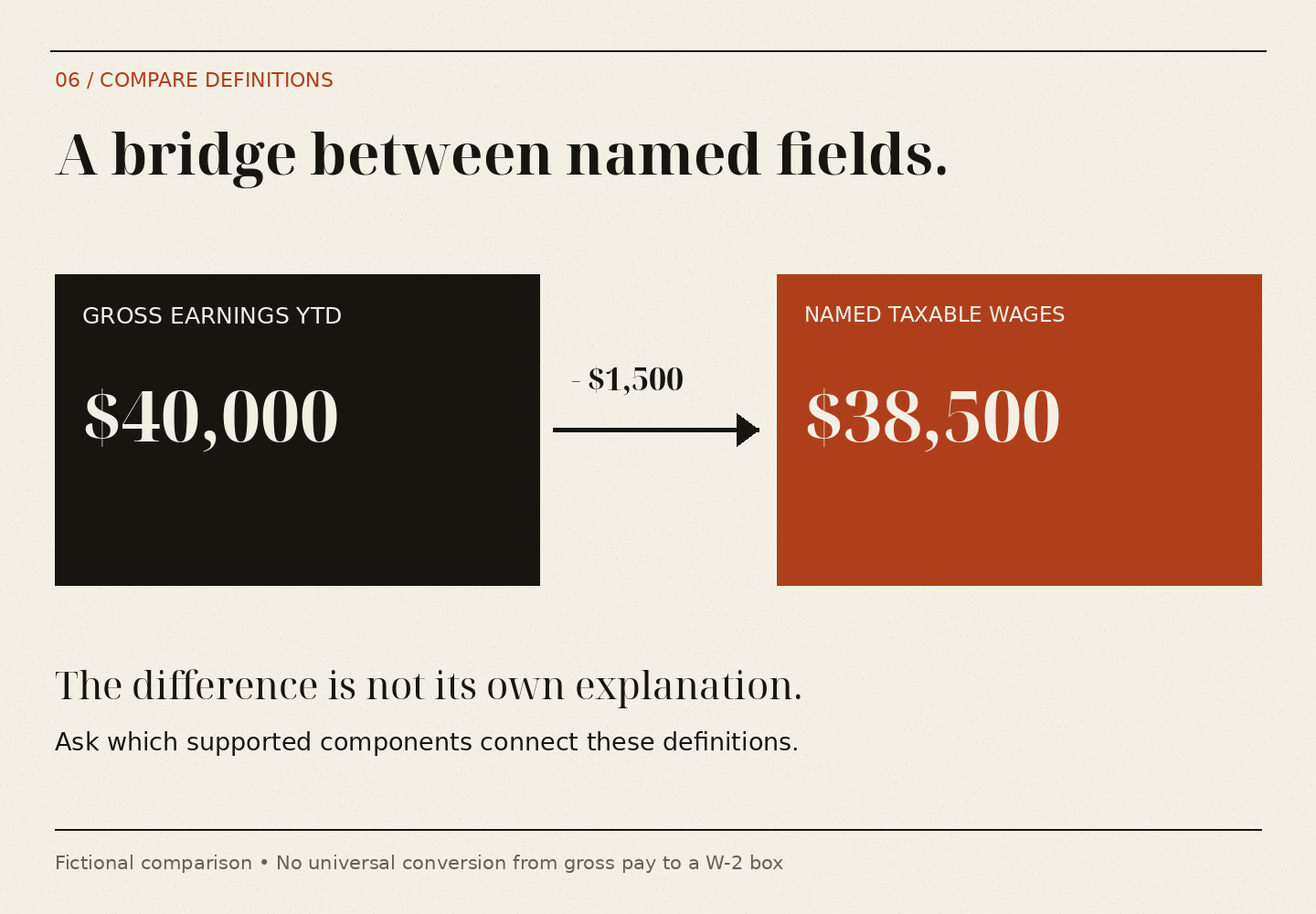
Suppose a fictional final statement shows gross earnings YTD of $40,000.00 and a separate federal taxable-wages YTD field of $38,500.00. A tax form shows $38,500.00 in its federal wage box. The matching taxable-wages figures are a different comparison from the $1,500.00 difference between gross earnings and that box.
The difference is not automatically an error. Nor does its size tell you which deduction or benefit explains it. Ask for the inclusion and exclusion rules that connect those fields. A numerical match is useful evidence about a relationship, but it does not independently validate the classification behind it.
A reader should preserve all three labels in the note. Replacing them with “income” erases the distinction that makes the comparison interpretable. The names are part of the evidence, not decoration around the numbers.
Build a bridge with explained components
Imagine payroll supplies a fictional explanation identifying $1,500.00 of items that are included in the statement's gross earnings but excluded from the named federal taxable-wages field. The bridge is then $40,000.00 minus $1,500.00 equals $38,500.00, under that supplied explanation.
Do not invent the $1,500.00 component just because subtraction reveals it. Until the employer identifies the included categories, it is an unexplained difference. Many different combinations can produce the same total, and arithmetic alone cannot select the correct one.
Once an explanation is provided, check whether its components add to the difference and whether they refer to the same year and employer. Keep the source of the explanation attached. The bridge should be a documented relationship, not a guess made to force equality.
Withholding deserves its own comparison
A wage box and a tax-withheld box measure different things. Compare the tax form's named withholding field with the corresponding cumulative withholding field on the pay record, if the employer identifies them as comparable. Do not compare withholding with total deductions that include benefits or other categories.
For a fictional example, the final statement has federal income tax withheld YTD of $3,200.00 and all deductions YTD of $6,100.00. A tax form showing $3,200.00 of federal income tax withheld is not missing the difference between those two statement fields. The broader deductions total includes other amounts by definition in this example.
If the corresponding withholding fields differ, record the direction and amount of the gap. Ask whether there are corrections or other records that explain it. The publication does not calculate a replacement value or tell you how to file while a discrepancy is unresolved.
Keep separate wage bases separate
A tax form can contain distinct federal, Social Security, Medicare and state wage fields. Do not assume all should equal the final statement's gross earnings or one another. The actual definitions and treatment of the underlying items matter.
This article intentionally avoids building a universal conversion formula. Such a formula would need facts about the person's compensation and applicable rules that a generic reading exercise cannot supply. The official form instructions are a starting reference, while individualized questions may require payroll or qualified tax guidance.
A useful question names the pair of fields: “How does the YTD field labeled X on my final statement relate to box Y on this form?” That is more answerable than “Why does my W-2 not match?” It also helps the recipient explain exactly which comparison is appropriate.
Treat a corrected form as a version relationship
If a corrected form appears, identify what changed and which earlier form it corrects. Do not add the old and new figures as though they represent separate earnings. The correction's instructions and a qualified explanation should guide how the documents are used.
For record reading, keep a brief chronology of versions and their relevant fields. A later date alone is not enough to determine the relationship; the correction label and source explanation matter. Preserve unanswered questions rather than discarding the earlier record solely to simplify the folder.
The practical endpoint is a small reconciliation note: records compared, definitions used, explained bridge amounts and any unresolved difference. That note can make a payroll or tax conversation more focused without claiming to complete it. A year-end comparison succeeds when it clarifies what the numbers mean, even if the correct next step is to ask a specialist.
Sources and scope
Official context checked October 14, 2026. The methods and worked figures are original educational examples. No individual legal or tax determination, deposit forecast or account service is provided.